

What does trust mean for brands in 2026? Is it still a soft brand metric, or has it become a commercial necessity?
To answer those questions, Clearcast brought together 16 senior leaders from across the advertising industry – including CMOs, creative leaders, regulators, production specialists and industry bodies – for a candid discussion on the future of trust in advertising.
The result is The new ROI: what UK marketing leaders really think about trust – our first trust report which examines how brands are navigating a landscape shaped by AI, influencers, changing consumer attitudes and increasing scrutiny.
Here we share an exclusive peek at one of the sections of the report – invaluable insights from our guest speaker, Lord Mark Price – but, you can also download your full copy below.
The trust report explores:
- The current state of trust in advertising
- Lord Mark Price’s framework for understanding trust
- Whether media environments affect consumer trust
- How advertising can actively build trust
- The role of regulation in a rapidly changing media landscape
- AI, LLMs and the future of brand trust
- Seven key principles agreed by the roundtable
- Where the industry goes from here
- Ten practical steps towards trusted advertising
While there are plenty of thought-provoking discussions throughout, here’s a peek into one section which offers valuable lessons for brands of all sizes.
The four kinds of trust: a framework for modern brands
Lord Mark Price, Founder of WorkL and former Managing Director of Waitrose, argues that trust is often misunderstood.
Price has developed a framework across decades of leadership. Trust, he argues, is not one thing. It’s four things, and most organisations are only actively managing one or two of them.
1. Self-trust
The first is self-trust.
“Do you trust yourself to make a decision before someone else trusts you to make one?” Price asks.
It sounds simple. In practice, Price argued, itʼs the foundation on which everything else rests. Leaders who lack self-confidence communicate it, whether they intend to or not. Teams that sense it stop bringing their real views to the table.
2. Trust in your people
The second is trust in the people around you. This, Price suggested, is where most organisations are currently failing.
“The deficit of trust now is really about that: do I trust what this person is saying?” The answer, too often, is no. And the reason is cultural.
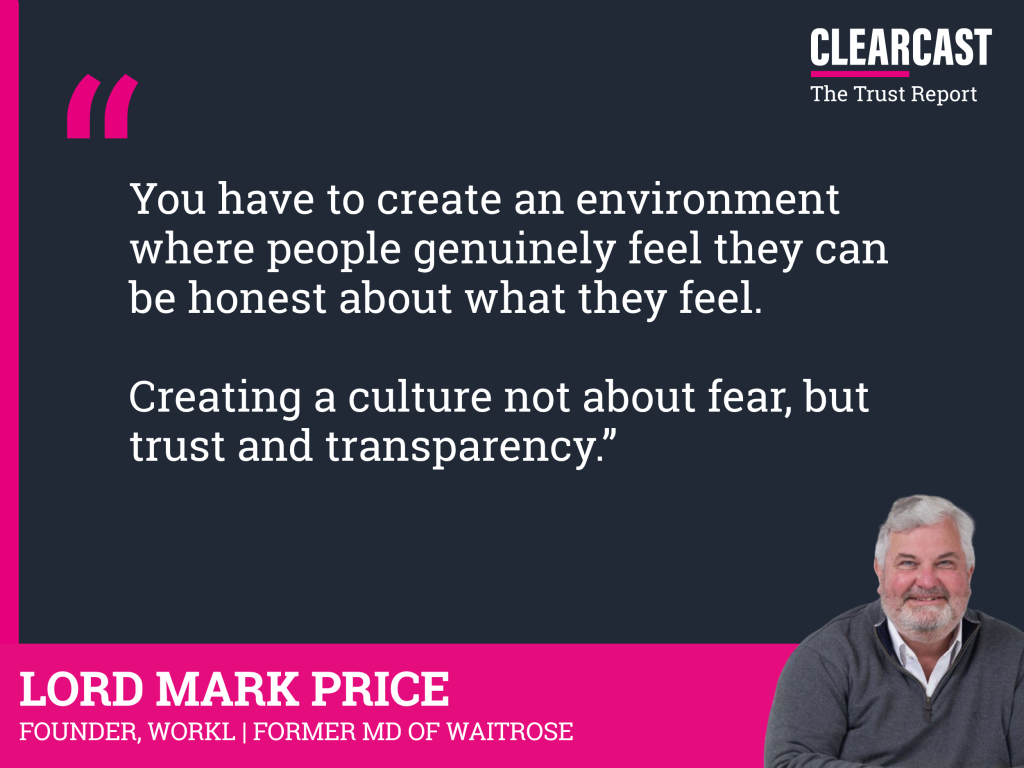
He illustrated the point with a contrast between his experience in politics and his experience at Waitrose. In government, he found a world built on managed messaging, where what was said publicly bore little relationship to what may have been believed privately. At Waitrose, he built something deliberately different. On every board debate, he would ask the person most opposed to a proposal to make the case against it: publicly, formally, as part of the process.
“I would legitimise their opposition. And at the end of it, having heard the debate, we would come to a consensus.”
The point was to make disagreement safe, so that when a decision was reached, it was one the whole organisation could stand behind.
3. Trust in your product or service
The third kind of trust is trust in the product or service. Price was forensic here. At Waitrose, the brand carried a perception of premium pricing that customers accepted until they stopped accepting it.
The response was not to slash prices or run promotions. It was to be radically transparent. Waitrose began publicly benchmarking their everyday staples against Tesco, showing customers that on the basics, they were paying the same price. Once that was established, the premium on everything else became believable.
“We launched a campaign where we benchmarked everyday items in Tesco. Identical item, same price. When customers knew that, they stopped questioning us when our beef was 50% more expensive.”
“Being honest and straightforward about your products became a really big focus.”
4. Trust in society
The fourth is trust in society: the relationship between a brand and the community it operates in. Price’s example here was the green token scheme, now familiar in supermarkets across the country, but pioneered at Waitrose. The idea was simple: give customers a token at the till, let them drop it into one of three local causes, and donate accordingly.
“What we were trying to do was work with the community to build trust.”
What made it work was not the money. It was the transparency: the visible, tangible connection between a customer’s choice and a community outcome.
The lesson for marketers
Perhaps the most important takeaway from this section is that trust cannot be built solely through marketing communications.It’s shaped by leadership decisions, company culture, customer experience and the relationship a brand has with society. Advertising can strengthen trust, but only when it’s built on a foundation that already exists.
Price’s comments also serve as a warning. Trust takes years to build and can disappear surprisingly quickly. Later in the report, he reflects on the horsemeat scandal that affected the food industry, describing how Waitrose voluntarily disclosed a separate contamination issue, despite not being implicated in the wider crisis.
His advice for brands facing difficult situations was unequivocal: “My advice always: fess up quickly. Be honest. And people will then trust you.”
Discover the rest of the report
Lord Mark Price’s four kinds of trust is just one chapter that made up part of a much broader discussion on the role that trust plays in advertising and brand growth today. Inside your copy of the full report you’ll also find exploration into:
- Why trust is becoming a measurable commercial advantage rather than a traditional brand metric
- The uncomfortable reality of competing against unregulated content, claims and competitors that don’t play by the same rules
- How AI and large language models are creating entirely new trust challenges for brands
- The growing influence of creators and influencers, and why trust is increasingly being earned through people rather than institutions
- What brands can learn from organisations including giffgaff, L’Oréal, Paddy Power and Pernod Ricard about maintaining trust in highly scrutinised industries
- The relationship between authenticity and effectiveness
- The practical challenges faced when balancing innovation, creativity and compliance
- Practical actions brands can take to build trust over time
If trust is becoming the new ROI, then these are conversations that every marketer should be paying attention to.
Download your copy:
Join the next discussion
Are you a senior marketing professional? Register your interest to join one of our next trust events. As the series continues, we’ll further explore this vital topic and what it means for our industry, whilst delving deeper into some key areas which are particularly affecting it today.